
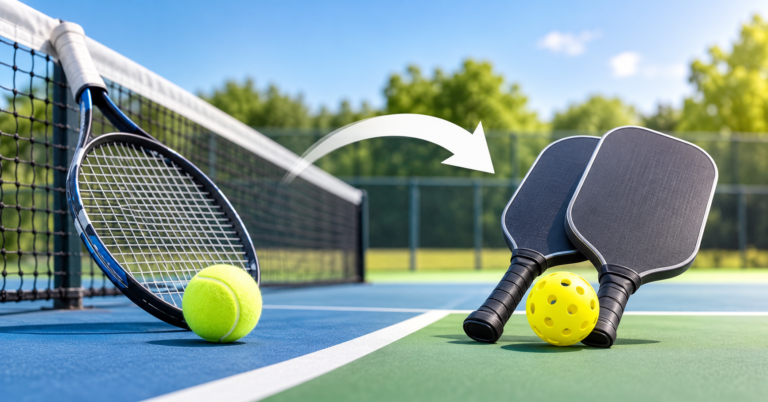
You already know how to split-step, read spin off an opponent’s racket, and finish a volley at the net. So why does your first pickleball game feel strange? Because a few of the rules work against the instincts tennis gave you. The good news: the tennis to pickleball transition is one of the easiest moves in racquet sports, as long as you know which habits to keep and which to drop. This guide covers what changes, the new shots you need, a simple four-week plan, and how to find pickleball lessons for tennis players that fit your level.
What Changes Most When You Switch from Tennis to Pickleball?
The court gets smaller, the swing gets shorter, and points are won with placement and patience rather than pace. A pickleball court is 20 feet wide and 44 feet long, with a net 34 inches high at the center and 36 inches at the sidelines. On each side of the net sits a 7-foot non-volley zone, called the kitchen, where you cannot hit the ball out of the air. Serves are hit underhand, and the ball must bounce once on each side before anyone can volley. Your footwork, hand-eye coordination, and net awareness carry over. Your full swing, overhead serve, and serve-and-volley reflex need to change.
Why Tennis Players Have a Head Start
Pickleball for tennis players starts several steps ahead of a complete beginner. You already understand court positioning in doubles, you can track a moving ball, and you know how to recover to a ready position between shots. Your net skills are likely ahead of most new players.
That head start is also the trap. Because the game feels familiar, many tennis players keep playing tennis on a pickleball court. They beat beginners, then stall against players who keep the ball low and soft. The players who improve fastest are the ones who treat pickleball as a new sport that happens to use skills they already own.
Tennis vs Pickleball Technique: What Carries Over and What Changes
This table compares tennis vs. pickleball technique so you can see where to adjust.
|
Area |
In tennis | In pickleball | What to do |
|
Grip |
Eastern or semi-western forehand grip | Continental grip for most shots | Start with continental and adjust later. |
| Swing | Long backswing and full follow-through | Short, compact stroke from the shoulder | Finish with the paddle out in front of you |
|
Serve |
Overhead, built for power |
Underhand contact below the waist |
Aim deep and favor consistency over speed. |
|
After the serve |
Often rush the net. |
Stay back until the return bounces. |
Wait for the bounce, then move forward. |
|
Net play |
Close in and put the ball away. |
Stay behind the kitchen line and dink. |
Be patient until you get a high ball. |
| Ball | Felt ball with a high, heavy bounce | Plastic ball with holes and a low bounce |
Bend your knees and stay low. |
| Ready position | Sideways turns on many volleys | Square to the net, paddle up. |
Keep the paddle in front of your chest |
Five Tennis Habits to Unlearn First
Swinging Too Big
A pickleball court is about half the length of a tennis court, and the plastic ball does not dip the way a heavy topspin tennis ball does. A full tennis swing sends the ball long. Think of each stroke as a push from the shoulder that ends with the paddle pointing at your target.
Rushing the Net After Your Serve
Serve-and-volley does not work here. The two-bounce rule means the return must bounce on your side before you can volley it. If you sprint forward after serving, you get caught in the middle of the court with the ball at your feet. Stay back, let the return bounce, then move up.
Turning Sideways at the Net
At the kitchen line, exchanges happen fast and from close range. Turning your shoulders like a tennis volley costs time you do not have. Stay square to the net, keep the paddle in front of your body, and block the ball rather than swinging at it.
Going for Winners from the Back
In tennis, a hard drive from the baseline can win the point. In pickleball, the team at the kitchen line usually controls the rally, and a hard drive often comes back at your feet. Use placement and soft shots to earn your way forward first.
Forgetting the Kitchen on Volleys
You cannot volley while standing in the kitchen or on its line, and you cannot let your momentum carry you into it after a volley. Plant your feet behind the line before you hit.
Three New Shots Every Tennis Convert Needs
The Dink
A dink is a soft shot that drops into your opponent’s kitchen, so they cannot attack it. It is like a tennis drop volley you might hit ten times in one rally. Lift the ball with your legs and shoulder, not your wrist, and aim to clear the net by a small margin.
The Third-Shot Drop
After the serve and return, the serving team hits the third shot. A drop is a soft, arcing ball that lands in the kitchen and gives you time to move forward. Most tennis players find this the hardest shot to learn because nothing in tennis asks you to hit softly from the baseline.
The Reset
When an opponent drives a hard ball at you, a reset takes the pace off and drops it back into the kitchen. Tennis teaches you to counter with power. Instead, soften your grip, absorb the ball, and send it low.
A Four-Week Plan for Pickleball for Tennis Players
You do not need months of drills before you play. This plan builds the right habits alongside real games.
- Week 1, rules and serve: Learn the serve, the two-bounce rule, the kitchen rule, and doubles scoring, where the server calls three numbers. Book one beginner clinic or lesson and join a beginner open-play session.
- Week 2, soft hands: Spend 15 minutes of each session dinking cross-court with a partner. Use the continental grip on every shot and count how many dinks you can hit in a row.
- Week 3, the third shot: Practice third-shot drops from the baseline, then follow each one by moving two or three steps forward. Expect plenty of misses at first.
- Week 4, play with a focus: In each game, choose one goal, such as no hard drives on the third shot or staying square at the net. Book a second lesson to check your progress.
Where to Get Pickleball Lessons for Tennis Players
A good coach spots tennis habits you cannot feel yourself and saves you weeks of trial and error. Good places to look:
- Coach directories: The Professional Pickleball Registry (PPR) keeps a searchable coach directory at pickleballwithrob.com and pprpickleball.org, and PlayPickleball.com lets you search for instructors by location.
- Your tennis club: Many tennis clubs now run pickleball clinics, often led by tennis pros who made the switch themselves and understand your habits.
- Pickleball facilities and recreation centers: Pickleball venues, YMCAs, and community centers often run beginner clinics.
- Outside the US: Check your national pickleball association or local club listings, since many now publish coach and court information.
Private Lesson, Clinic, or Open Play?
Start with one private lesson if you can, because a coach can focus only on your tennis habits. Group clinics cost less and give you more repetitions with different partners. Open play is where you test it all. A mix of the three usually works best.
Questions to Ask Before You Book
- Have you coached many tennis players, and what do they usually struggle with?
- Are you certified? USA Pickleball recognizes several certification programs, including PPR, PCI, and IPTPA.
- What will we work on in the first session?
- Do you use video so I can see my swing?
Keep in mind that certification means a coach was trained to teach. It does not always mean they play at a high level, and a great communicator is often the better choice.
Make the Switch One Habit at a Time
Your tennis background is a real advantage, but only if you let pickleball be its own game. Shorten your swing, respect the kitchen, and learn to win points softly. Take one habit from this guide to your next session, and book a lesson with a coach who knows tennis players. Your tennis to pickleball transition will move faster than you expect, and you might find a second favorite sport along the way.
Frequently Asked Questions
Is it easy to switch from tennis to pickleball?
Yes, for most players. Your footwork, timing, and net skills carry over. The tricky part is shrinking your swing, serving underhand, and staying out of the kitchen on volleys.
How long does the tennis to pickleball transition take?
Most tennis players can join casual games within a week or two. Getting comfortable with dinks, drops, and resets usually takes two to three months of regular play and practice.
Do tennis players need pickleball lessons?
You can learn on your own, but one or two lessons early on help a lot. A coach spots tennis habits like big swings and rushing the net before they turn into hard-to-fix patterns.
Can you play pickleball on a tennis court?
Yes. Up to four pickleball courts fit on one tennis court, and many clubs add painted lines and portable nets. The net center must be lowered to 34 inches for regulation play.
What is the hardest part of pickleball for tennis players?
Patience. Tennis rewards hitting through the ball, while pickleball points are often won by keeping the ball low and soft until the opponent gives you a high, easy ball.