
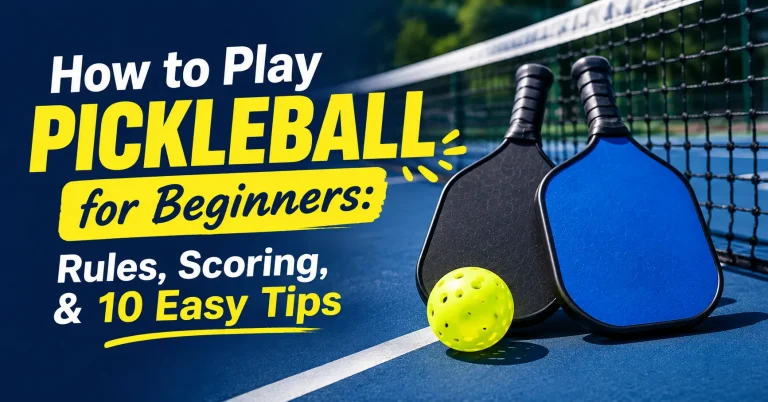
Pickleball is one of the fastest-growing sports in the world, and it’s easy to see why. It mixes the fun of tennis, badminton, and ping pong into one simple game that almost anyone can pick up in a single afternoon. If you’re searching for how to play pickleball for beginners, you’re in the right place. This guide breaks down the rules, scoring, and easy tips you need to start playing with confidence, even if you’ve never held a paddle before.
One of the biggest reasons pickleball has become so popular is how quickly new players can start having fun. Unlike sports that take months to feel comfortable in, most beginners can learn the core rules and play a full game within their very first visit to the court. The smaller playing area, lighter paddle, and slower-moving ball make it far less intimidating than tennis, which is why players of every age, from kids to grandparents, enjoy playing together.
What Is Pickleball: Basics and Fundamentals
Before jumping into the rules, it helps to understand the pickleball basics and fundamentals that make this game unique.
Pickleball is played on a court about the size of a badminton court, which is much smaller than a tennis court. It can be played as singles (one player per side) or doubles (two players per side), though doubles is the most popular format for beginners.
Here’s what you need to get started:
- A paddle: Lightweight and solid, made of wood or composite material.
- A pickleball: A plastic ball with holes, similar to a wiffle ball.
- A net: Set at 36 inches on the sides and 34 inches in the middle.
- Court shoes: Non-marking shoes with good grip for quick lateral movement.
The court is divided into sections, including a “non-volley zone” near the net, often called the kitchen. This area plays a major role in how the game is played and strategized, so understanding it early will help you avoid common beginner mistakes.
Another fundamental to know is how the court is laid out. Each side has a service area split into left and right boxes and a centerline that determines where serves must land. Learning these zones by sight, rather than memorizing measurements, will make your first few games much smoother. Most community courts also have clear line markings and a lower net height, so you don’t need to worry about precise setup if you’re playing at a public facility.
Pickleball Rules for Beginners
Learning the pickleball rules for beginners doesn’t take long, since the game was designed to be simple and approachable. Here are the core rules every new player should know.
1. Serving Rules
The serve must be hit underhand, below waist level, and diagonally across the court into the opponent’s service box. Only one serve attempt is allowed unless a let occurs (the ball touches the net but still lands in the correct box, which is replayed).
2. The Double Bounce Rule
This is one of the most important pickleball basics to remember. After the serve, the receiving team must let the ball bounce once before returning it. Then the serving team must also let it bounce once before hitting it back. After these two bounces, players can either volley the ball (hit it in the air) or let it bounce.
3. The Non-Volley Zone (Kitchen)
Players cannot hit the ball out of the air while standing inside the seven-foot zone on either side of the net. This rule prevents players from smashing the ball right at the net, keeping the game fair and strategic.
4. Out of Bounds and Faults
If the ball lands outside the court lines, hits the net and doesn’t clear it, or a player commits a kitchen violation, it results in a fault. A fault ends the rally and can affect the score, depending on who committed it.
5. Line Calls
A ball that lands on any court line is considered “in,” similar to tennis. Only when the ball completely misses the line is it called “out.”
6. Two-Bounce Recovery
If you’re unsure whether the ball has bounced twice on your side, it’s better to let it bounce and play it safe rather than volleying too early. A single mistimed volley before the double bounce rule is satisfied results in an automatic fault, so beginners should always pause and count the bounce before swinging.
These pickleball rules for beginners might feel like a lot at first, but most players find they only need one or two games before the rules start to feel natural.
How to Keep Score in Pickleball
Many beginners find scoring confusing at first, but once you understand the pattern, it becomes second nature. Here’s how to keep score in pickleball step by step.
Games are typically played to 11 points, and you must win by at least 2 points. Only the serving team can score a point, which makes serving consistency important.
During doubles play, each player on the serving team gets a chance to serve before the serve passes to the other team, except at the very start of the game, when only one partner serves before the side-out.
The score is called out using three numbers:
- The serving team’s score
- The receiving team’s score
- The server number (1 or 2)
For example, if the score is called “4-2-1,” it means the serving team has 4 points, the receiving team has 2 points, and the first server on the team is currently serving. This calling system helps every player on the court stay updated on the score and whose turn it is to serve.
It’s worth noting that singles scoring works slightly differently than doubles, since there’s no second server number to call. In singles, the score is simply announced as two numbers, such as “4-2,” and the serving side alternates service courts based on whether their score is even or odd. Once you’ve played a few games, calling the score becomes automatic, and it actually helps players stay focused and avoid disputes mid-game.
10 Easy Tips for Pickleball Beginners
Now that you understand the basics, here are 10 easy tips to help you play smarter and improve faster.
1. Start with soft dinks near the net
Practice gentle, controlled shots called “dinks” that land softly in the opponent’s kitchen. This builds control before power.
2. Keep your paddle up and ready
Holding your paddle at chest height helps you react quickly to fast shots and reduces reaction time during rallies.
3. Master the underhand serve first
Since every point starts with a serve, spend extra time practicing a consistent, accurate underhand serve before worrying about power.
4. Stay out of the kitchen unless necessary
Avoid standing in the non-volley zone unless you’re about to hit a bounced ball. Stepping back keeps you within the rules.
5. Communicate with your doubles partner
Simple calls like “mine,” “yours,” or “bounce it” prevent confusion and missed shots during fast exchanges.
6. Aim for consistency over power
Beginners often lose points by hitting too hard. Focus on keeping the ball in play rather than trying to win every shot outright.
7. Move as a team in doubles
Try to move side to side and forward to back together with your partner to avoid leaving gaps in your coverage.
8. Watch the ball, not your opponent
Keeping your eyes on the ball, especially near the net, improves your timing and reaction speed.
9. Practice your return of serve
A strong return sets up the rest of the rally. Aim deep into the court to give yourself more time to get to the net.
10. Play often and track your progress
Like any sport, pickleball basics and fundamentals improve with repetition. Playing regularly, even for short sessions, builds muscle memory faster than occasional long sessions.
Conclusion
Pickleball is a welcoming sport that rewards patience, strategy, and steady improvement rather than raw power alone. By learning the rules, understanding how scoring works, and practicing these 10 tips, beginners can feel confident stepping onto the court within just a few sessions. Grab a paddle, find a local court, and start enjoying one of the most social and beginner-friendly sports around.
Frequently Asked Questions
What are the basic rules of pickleball for beginners?
Beginners must serve underhand diagonally, let the ball bounce once on each side after the serve, and avoid volleying inside the non-volley zone near the net.
How do you keep score in pickleball?
Only the serving team scores points. Games are usually played to 11, winning by 2. The server calls three numbers: their score, the opponent’s score, and the server number.
What is the double bounce rule in pickleball?
The double bounce rule means the ball must bounce once on the serving side and once on the receiving side before either team can volley it in the air.
Can beginners play pickleball without prior experience?
Yes, pickleball is beginner-friendly. Its smaller court, slower ball, and simple scoring make it easy to learn the basics within a single practice session.
What equipment do I need to start playing pickleball?
You need a paddle, a plastic perforated pickleball, comfortable non-marking court shoes, and access to a marked pickleball or tennis court to begin playing.