
Introduction
Pickleball and tennis are two beloved racquet sports that share some similarities but also have distinct differences. Whether you’re a seasoned player looking to expand your horizons or a newcomer trying to decide which sport to pursue, understanding the contrasts between pickleball and tennis is essential.
In this comprehensive guide, we’ll explore the top 20 differences between pickleball and tennis, shedding light on everything from equipment and court size to gameplay and strategy.

Let’s dive in and uncover what sets these two sports apart!
-
Court Size and Layout
Pickleball: Pickleball courts are smaller than tennis courts, measuring 20 feet wide and 44 feet long for doubles play and 20 feet wide and 22 feet long for singles play. The court is divided into halves by a 34-inch high net, with non-volley zones (kitchens) located near the net on both sides.
Tennis: Tennis courts are larger, measuring 78 feet long and 27 feet wide for singles play and 36 feet wide for doubles play. The court is divided into halves by a net that stands 3 feet high at the center and 3.5 feet high at the posts.
-
Equipment
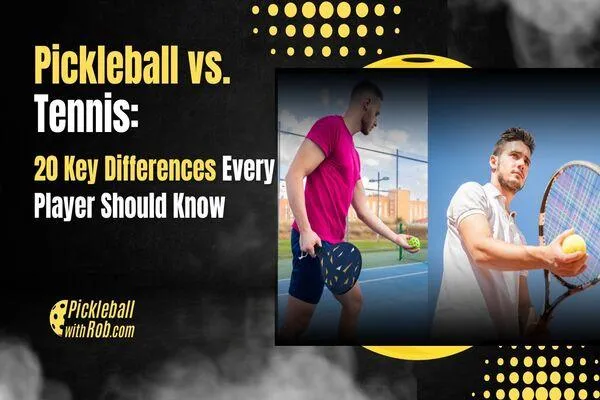
Pickleball: Pickleball is played with a solid paddle made of wood, composite materials, or graphite. The paddle is larger than a tennis racket and has a shorter handle. Pickleball also uses a perforated plastic ball similar to a wiffle ball but smaller and heavier than a tennis ball.
Tennis: Tennis is played with a strung racket made of graphite, carbon fiber, or other materials. The racket has a longer handle and a larger hitting surface than a pickleball paddle. Tennis balls are larger and heavier than pickleballs, with a felt covering.
-
Serving Technique
Pickleball: In pickleball, serves must be made underhand and below the waist, with the server standing behind the baseline. The serve is delivered diagonally across the court, and the server must allow the ball to bounce once before returning.
Tennis: In tennis, serves can be made overhand or underhand, with the server standing behind the baseline. The serve can be directed anywhere within the opponent’s service box, and there are no restrictions on where the ball must bounce after the serve.
-
Scoring System
Pickleball: Pickleball typically uses a rally scoring system, where points can be won by the serving or receiving team. Games are usually played to 11 points, and players must win by at least two points.
Tennis: Tennis traditionally uses a non-rally scoring system, where only the serving team can score points. Games are played to 4 points, with points being awarded as 15, 30, 40, and game. Players must win by at least two points, and sets are typically played to 6 or 7 games.
-
Speed of Play
Pickleball: Pickleball is generally played at a slower pace than tennis, with shorter rallies and less running required due to the smaller court size. This makes pickleball a more accessible sport for players of all ages and fitness levels.
Tennis: Tennis can be played at a faster pace, with longer rallies and more running involved due to the larger court size. This can make tennis more physically demanding, especially at higher levels of play.
-
Strategy and Tactics
Pickleball: Pickleball strategy often revolves around placement, accuracy, and shot selection, with players aiming to control the pace of the game and exploit their opponents’ weaknesses. Strategies such as dinking, lobbing, and attacking the net are commonly used to gain an advantage.
Tennis: Tennis strategy encompasses a wide range of tactics, including power, spin, and placement, with players seeking to outmaneuver and outsmart their opponents. Strategies such as serving and volleying, baseline rallying, and approaching the net are employed to dictate play and win points.
-
Net Play
Pickleball: Net play is a crucial aspect of pickleball, with players frequently volleying and dinking at the net to set up winning shots. The non-volley zone (kitchen) restricts players from volleying within 7 feet of the net, adding a strategic element to net play.
Tennis: Net play is also important in tennis, with players utilizing volleys, overhead smashes, and drop shots to control the flow of the game. Unlike pickleball, there are no restrictions on where players can volley from on the court.
-
Grip and Stance
Pickleball: In pickleball, players typically use a continental grip for most shots, which involves holding the paddle with the knuckles of the index finger and thumb on the top of the grip. The stance is generally square to the net, with weight evenly distributed between the feet.
Tennis: In tennis, players may use a variety of grips depending on the type of shot being executed, including the eastern forehand grip, continental grip, and western backhand grip. The stance varies depending on the shot, with players often adopting an open or closed stance to generate power and control.
-
Ball Spin
Pickleball: Pickleballs are designed to minimize spin, with a smooth surface and uniform weight distribution. While players can generate some spin through the use of spin shots such as topspin and backspin, it is less pronounced than in tennis due to the ball’s construction.
Tennis: Tennis balls are designed to maximize spin, with a felt covering that allows players to impart topspin, backspin, slice, and kick on the ball. Spin plays a significant role in shot execution and strategy, affecting the trajectory and bounce of the ball.
-
Footwork
Pickleball: Footwork in pickleball is focused on agility, balance, and quickness, with players moving laterally and diagonally to cover the court efficiently. The smaller court size allows for shorter, more controlled steps, reducing the need for long strides or sprints.
Tennis: Footwork in tennis is more varied, incorporating lateral movement, split steps, and directional changes to position the body for optimal shot execution. The larger court size requires players to cover more ground, requiring longer strides and faster sprints to reach the ball.
-
Court Surface
Pickleball: Pickleball courts can be played on a variety of surfaces, including indoor and outdoor courts made of asphalt, concrete, or synthetic materials. The surface texture may vary, with some courts featuring a smooth finish for faster play and others featuring a textured finish for better traction.
Tennis: Tennis courts are typically made of asphalt, concrete, clay, or grass, each offering unique playing characteristics. Clay courts provide slower play with higher bounce, while grass courts offer faster play with lower bounce. Hard courts offer a medium-paced surface suitable for all playing styles.
-
Serve and Return
Pickleball: In pickleball, the serve is delivered underhand and must land within the opponent’s service court diagonally across the net. The return of serve is crucial, with players aiming to return the ball deep and low to prevent their opponents from attacking the net.
Tennis: In tennis, the serve is delivered overhand and can be directed anywhere within the opponent’s service box. The return of serve is equally important, with players seeking to neutralize their opponent’s advantage and gain control of the rally.
-
Ball Speed
Pickleball: Pickleballs are lighter and slower than tennis balls, with less velocity and bounce off the paddle. This makes pickleball more accessible to players of all ages and skill levels, as it requires less power and strength to control the ball.
Tennis: Tennis balls are heavier and faster than pickleballs, with greater velocity and bounce off the racket. This can make tennis more physically demanding, especially at higher levels of play where power and speed are essential.
-
Double Bounce Rule
Pickleball: In pickleball, the double bounce rule requires that the ball must bounce once on each side of the net before players can begin volleying. This rule encourages longer rallies and strategic shot placement, as players must wait for the ball to bounce before attacking the net.
Tennis: There is no double bounce rule in tennis, allowing players to volley the ball directly after the serve if they choose. This can lead to faster-paced rallies and more aggressive play, as players have the option to attack the net immediately.
-
Court Lines
Pickleball: Pickleball courts are marked with boundary lines for singles and doubles play, including baselines, sidelines, and non-volley zones (kitchens). The lines are typically painted or taped onto the court surface for visibility and clarity.
Tennis: Tennis courts are marked with boundary lines for singles and doubles play, including baselines, sidelines, service lines, and center service lines. The lines are usually painted or chalked onto the court surface and may vary in color depending on the court type.
-
Net Height
Pickleball: The net height in pickleball is 34 inches at the center and 36 inches at the posts, allowing for comfortable play and easy visibility. The lower net height reduces the risk of injury and encourages players to engage in more net play.
Tennis: The net height in tennis is 3 feet at the center and 3.5 feet at the posts, providing a barrier between players and facilitating shot placement. The higher net height requires players to generate more power and accuracy to clear the net with their shots.
-
Serve Speed
Pickleball: Pickleball serves are typically slower than tennis serves, with less emphasis on power and more focus on placement and accuracy. The underhand serve technique allows players to control the ball and initiate rallies without relying on excessive force.
Tennis: Tennis serves can be delivered at high speeds, with top players routinely exceeding 100 miles per hour on their first serves. The overhand serve technique allows players to generate power and spin, making it difficult for opponents to return the ball effectively.
-
Equipment Cost
Pickleball: Pickleball equipment is generally more affordable than tennis equipment, with paddles ranging from $20 to $150 and balls costing around $5 to $10 per dozen. This makes pickleball a cost-effective option for players looking to get started without breaking the bank.
Tennis: Tennis equipment can be more expensive, with rackets ranging from $50 to $300 or more and balls costing around $2 to $5 per can. Additional expenses such as court fees, lessons, and tournament entry fees can further increase the overall cost of playing tennis.
-
Community and Culture
Pickleball: Pickleball has a tight-knit and welcoming community, with players of all ages and skill levels coming together to enjoy the sport. Tournaments, social events, and leagues are popular among pickleball enthusiasts, fostering camaraderie and sportsmanship.
Tennis: Tennis also has a strong community and culture, with a rich history and tradition that dates back centuries. Players of all ages and backgrounds participate in tennis, with opportunities for competitive play, recreational activities, and social gatherings.
-
Accessibility
Pickleball: Pickleball is known for its accessibility, with courts available in parks, recreation centers, schools, and private clubs around the world. The smaller court size and slower pace make pickleball easy to learn and play, attracting players of all ages and abilities.
Tennis: Tennis is widely accessible, with courts located in parks, schools, clubs, and public facilities worldwide. While tennis can be more physically demanding than pickleball, players of all ages and skill levels can enjoy the sport with proper instruction and equipment.
Conclusion
In conclusion, pickleball and tennis are two distinct sports with their own rules, equipment, and strategies. While they share some similarities, such as using a racket and ball to score points, the differences between pickleball and tennis are significant and worth exploring.
Whether you’re a pickleball enthusiast looking to learn more about tennis or a tennis player curious about pickleball, understanding these contrasts can enhance your appreciation for both sports.
So grab your paddle or racket, hit the court, and experience the thrill of pickleball and tennis for yourself!
FAQs:
-
Which sport is easier to learn, pickleball, or tennis?
Pickleball is generally considered easier to learn than tennis due to its smaller court size, slower pace, and simplified rules. However, both sports offer unique challenges and opportunities for skill development.
-
Can I play pickleball on a tennis court?
Yes, pickleball can be played on a tennis court with some modifications, such as using portable nets and tape to create pickleball boundaries. Many tennis facilities offer designated pickleball hours or courts to accommodate players.
-
Is pickleball suitable for all ages?
Yes, pickleball is suitable for players of all ages, from children to seniors. The sport’s smaller court size, slower pace, and lightweight equipment make it accessible and enjoyable for players of all abilities.
-
How long does it take to set up a pickleball court?
The time required to set up a pickleball court can vary depending on factors such as court size, surface material, and available resources. On average, you can expect the setup process to take anywhere from 30 minutes to a few hours, depending on your level of experience and preparation.
-
How much does it cost to build a pickleball court?
The cost of building a pickleball court can vary depending on factors such as court size, surface material, and additional features. On average, you can expect to spend anywhere from $500 to $2,000 for materials and equipment to create a basic court setup.
References:
-
USA Pickleball Association. (n.d.). Official Tournament Rulebook. Retrieved from
-
United States Tennis Association. (n.d.). Rules of Tennis. Retrieved from
https://www.usta.com/en/home/organize/play-tennis/tennis-rules.html
-
Pickleball Central. (n.d.). Pickleball Court Dimensions. Retrieved from
-
Tennis Warehouse. (n.d.). Tennis Court Dimensions. Retrieved from
https://www.tennis-warehouse.com/learning_center/courts.html